When Your Pool Turns Green: What It Means and What to Do
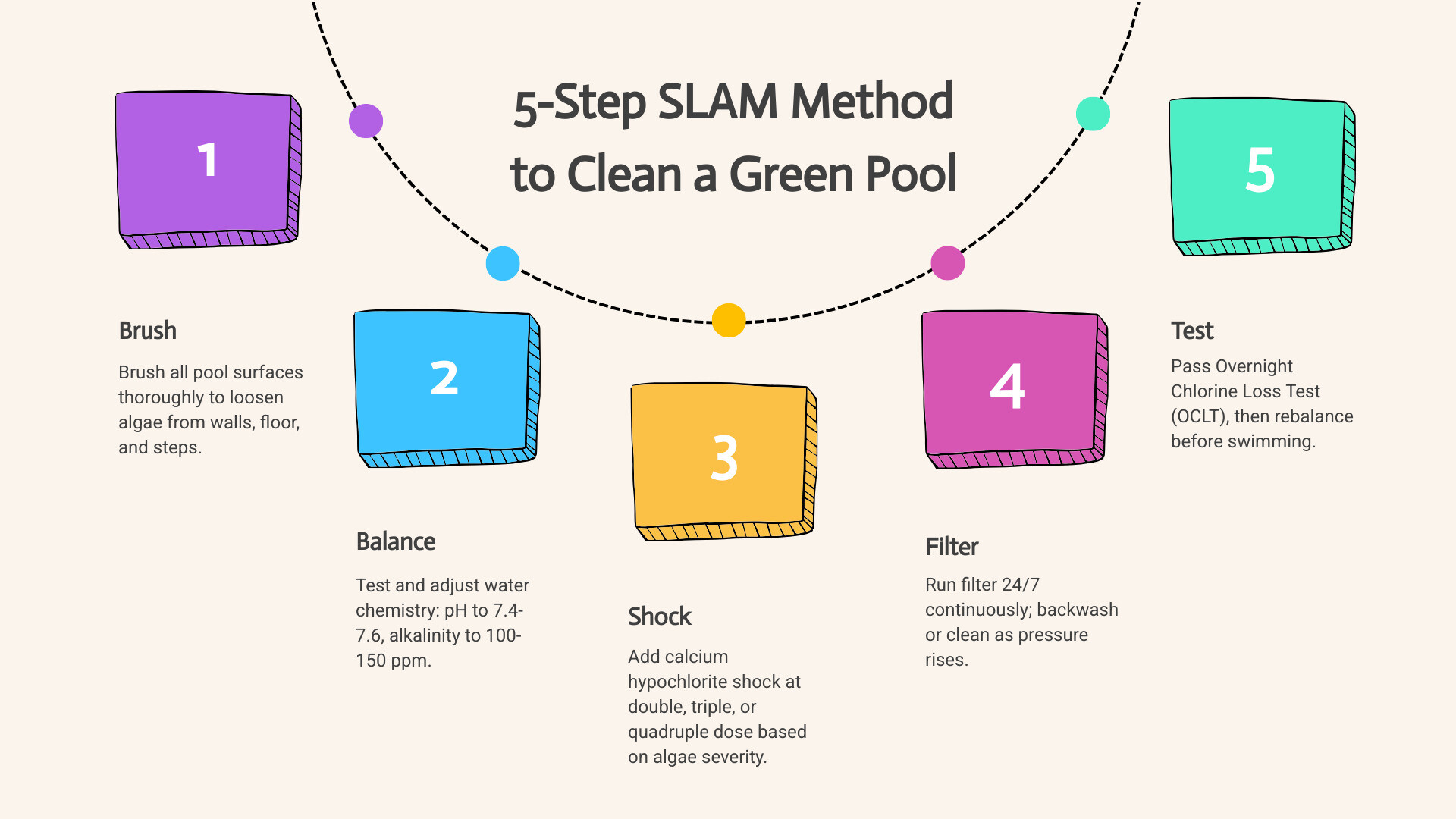
How to clean a pool that is green comes down to five key steps:
- Brush all pool surfaces to loosen algae
- Balance your water chemistry (pH and alkalinity first)
- Shock with calcium hypochlorite at the right dose for your algae level
- Run your filter continuously — 24 hours a day — until the water clears
- Test and rebalance once the water is clear before swimming
Most pools clear up within 4 to 5 days using this method.
If you’re a Houston homeowner, you know what summer heat and heavy rain can do to a pool that’s been left alone for even a week. One day it’s blue. The next, it looks like a swamp.
You’re not alone — and your pool isn’t ruined.
That green color almost always means algae has taken over, which happens when chlorine levels drop too low to keep it in check. The good news? You don’t need to drain your pool and start over. With the right steps and a little consistency, most green pools can be brought back to sparkling blue in just a few days.
This guide walks you through exactly how to do it — from identifying what’s causing the green to clearing the water and keeping it that way.
Know your how to clean a pool that is green terms:
Identifying the Culprit: Why is My Pool Green?
When you walk out to your backyard in Katy or The Woodlands and see a green tint, your first instinct might be panic. But before we start throwing chemicals at the problem, we need to understand what we’re fighting. In the Greater Houston area, our unique climate — high humidity, intense heat waves, and sudden heavy rainfall — creates a “perfect storm” for pool issues.
Most of the time, the culprit is algae spores. These tiny organisms are always present, but they only bloom when your sanitizer levels (chlorine) fall too low. However, algae isn’t the only thing that can turn your water a different shade.
Common Causes of Discoloration
- Low Chlorine Levels: This is the #1 cause. If your free chlorine drops below 1.0 ppm, algae can double in size every few hours in the Texas sun.
- Houston Heat Waves: When the temperature stays above 90°F for days on end, the water gets warm, and algae grows much faster.
- Heavy Rainfall: Houston storms wash nitrogen, organic debris, and even algae spores from your lawn directly into the pool. Rain also dilutes your chemicals and shifts your pH.
- Pollen Accumulation: During the spring in places like Sugar Land or Cypress, heavy yellow-green pollen can settle on the surface. If it’s pollen, the water is usually clear but has a green “dust” on top.
- Copper Oxidation: If you have an older heater with a copper heat exchanger or if you’ve used cheap, copper-based algaecides, the copper can oxidize. This turns the water a clear, emerald green (like a Sprite bottle) rather than a cloudy, swampy green.
Testing and balancing your water is the only way to know for sure what’s going on under the surface.
Determining the Cause of Your Green Pool
To figure out how to clean a pool that is green, you have to look at the “texture” of the green.
| Appearance | Likely Cause | Texture |
|---|---|---|
| Cloudy, murky green | Green Algae | Slimy walls and floor |
| Clear, emerald green | Copper/Metals | No slime, just tinted water |
| Yellow-green dust on top | Pollen | Wipes away easily |
| Dark green/Black spots | Black Algae | Rough, “rooted” into the plaster |
If the water is cloudy and the walls feel like they’ve been coated in okra slime, you’re dealing with a classic algae bloom. The first thing you should do is reach for your Test Strips to check your pH, Alkalinity, and Chlorine levels.
Preparation: Essential Tools and Chemicals
Before we dive into the SLAM method, we need to gather our supplies. Think of this like prepping for a big backyard BBQ — you wouldn’t start the grill without the charcoal and the tongs ready, right?
To tackle a green pool, you’ll need:
- A Telescopic Pole: The backbone of your cleaning kit.
- A Heavy Duty Round Pool Brush: To scrub the algae off the walls and get it into the water where the chlorine can kill it.
- Manual Vacuum: You’ll need this to suck up the dead algae once it settles.
- Cal-Hypo Shock: This is our preferred weapon. Calcium Hypochlorite (Cal-Hypo) is a strong, fast-acting shock that kills algae without adding too much Cyanuric Acid (stabilizer), which can lead to “chlorine lock.”
- Liquid Chlorine: Great for a quick boost of sanitizer.
- Water Balancers: You’ll need pH decreaser (muriatic acid or dry acid) and alkalinity increaser (baking soda).
- Protective Gear: Always wear gloves and eye protection when handling pool chemicals. They are powerful stuff!
For more tips on maintaining your investment, check out our guide on how to keep your custom pool looking brand new year after year.
Choosing the Right Brush for Your Surface
Not all brushes are created equal. Using the wrong one can actually damage your pool’s finish.
- Nylon Bristles: These are the standard. They are safe for all surfaces, including vinyl liners and fiberglass pools.
- Steel Brushes: These are heavy-duty. They are excellent for scrubbing algae off gunite (concrete) and plaster finishes, but never use them on vinyl or fiberglass, as they will scratch or tear the surface.
- Fiberglass Care: If we built you a custom fiberglass pool in Fulshear or Spring, stick to a soft nylon brush to keep that gel coat looking shiny and new.
How to Clean a Pool That Is Green: The Step-by-Step SLAM Method
The SLAM method stands for Shock, Level, And Maintain. It is the most reliable way to turn a “swamp” back into a “swim.”
Step 1: Remove Debris
Before adding chemicals, use a leaf net to scoop out as much organic matter as possible. Leaves and twigs sitting on the bottom will just soak up your chlorine, making the treatment less effective.
Step 2: Balance the Water
This is where many folks go wrong. Chlorine doesn’t work well if your pH is too high.
- pH: Aim for 7.2 to 7.5.
- Total Alkalinity: Aim for 80 to 120 ppm.
- Cyanuric Acid (CYA): This “sunscreen” for chlorine should be between 30 and 50 ppm. If it’s too high (over 70-80 ppm), you might experience “chlorine lock,” where the chlorine is “locked” and can’t kill the algae. In that case, you might need to partially drain and refill with fresh water.
Step 3: Shock the Water
Once your pH is in range, it’s time to apply Cal-Hypo Pool Shock Treatment. Always add shock in the evening after the sun goes down so the UV rays don’t burn off the chlorine before it can do its job.
Calculating Shock Levels for How to Clean a Pool That Is Green
The amount of shock you need depends on how green your pool is. A standard maintenance dose is usually 1 pound of shock per 10,000 gallons of water. For a green pool, you’re going to need a lot more.
- Light Green/Teal: Double Shock (2 lbs per 10,000 gallons).
- Dark Green: Triple Shock (3 lbs per 10,000 gallons).
- Black Lagoon (can’t see the bottom): Quadruple Shock (4 lbs per 10,000 gallons).
For a typical 20,000-gallon Houston pool that is moderately green, you’ll likely need 6 pounds of shock to start.
Daily Brushing and Filtration for How to Clean a Pool That Is Green
Shocking the pool is only half the battle. You have to keep the water moving and keep the algae off the walls.
- Run the Filter 24/7: Do not turn your pump off until the water is crystal clear. This might take 4 to 5 days.
- Brush Daily: Brush the walls and floor at least twice a day. This breaks the protective layer off the algae and lets the chlorine finish it off.
- Monitor Pressure: As the filter catches the dead algae, the pressure will rise. When it gets 8-10 PSI above your “clean” pressure, it’s time for a cleaning. If you need a refresher, check out our guide to cartridge filter cleaning.
- Dead Algae Removal: As the algae dies, it will turn a cloudy gray or white color and settle on the floor. You’ll need to vacuum this out. If your filter has a “waste” setting, vacuuming to waste is the fastest way to get it out of the system.
Troubleshooting and Clearing Cloudy Water
Sometimes, after shocking, your water turns from green to a cloudy, milky blue. This is actually good news! It means the algae is dead, but the particles are too small for your filter to catch quickly.
Using Flocculants and Clarifiers
If you’re in a hurry for a weekend pool party in Richmond or Tomball, you can use helpers:
- Pool Water Clarifier: This acts like a magnet, bunching tiny particles together so the filter can grab them.
- Flocculant (Floc): This is the “heavy hitter.” It makes everything sink to the floor overnight. You must then vacuum the “cloud” directly to waste. Warning: Do not use floc if you have a cartridge filter unless you can bypass it, as it can gum up the pleats.
The OCLT Test
How do you know when you’ve officially won the war? We recommend the Overnight Chlorine Loss Test (OCLT).
- Test your free chlorine (FC) after the sun goes down.
- Test it again the next morning before the sun hits the water.
- If you lost less than 1 ppm of chlorine overnight, the algae is gone!
Once you’ve passed the test, you can add a preventative Algaecide to keep the spores from coming back.
Frequently Asked Questions About Green Pools
How long does it typically take to clear a green pool?
For a standard bloom, expect it to take 4 to 5 days. If the pool has been neglected for months (like a “swamp” with tadpoles), it could take up to two weeks of consistent SLAMming and filtration. The key is patience — don’t stop the process just because it looks “better.” Wait until it’s crystal clear.
Is it safe to swim in a pool that is green?
We don’t recommend it. Green water can hide bacteria like E. coli, and the lack of visibility is a major safety risk — you can’t see the bottom if someone gets into trouble. Only swim once the water is clear and your free chlorine levels are below 4 ppm.
When should I drain my pool instead of treating it?
Draining a pool in Houston can be tricky because of our high water table (the ground is very “wet”), which can cause a pool to “pop” out of the ground if not handled correctly. Generally, you only need to drain if:
- The Total Dissolved Solids (TDS) are extremely high.
- The Cyanuric Acid (CYA) is over 100 ppm.
- The water is so thick with organic “muck” that chemicals would cost more than a refill.
Always consult with a professional before draining a pool in Harris or Montgomery County.
Your Partner in Houston Backyard Transformations
At Ocean Blue Pools, we’ve spent over 25 years helping our neighbors in Greater Houston build and maintain the backyards of their dreams. From the initial design in Sugar Land to the final tile placement in Magnolia, we pride ourselves on custom craftsmanship and transparent, Southern-friendly service.
We know that a pool is more than just a hole in the ground — it’s where your family makes memories, where you host the best BBQs in the neighborhood, and where you escape the Texas heat. Whether you’re dealing with a green pool or you’re ready to start from scratch with a brand-new design, we’re here to help.
Let’s design your dream backyard together and turn your outdoor space into a clear blue oasis that lasts for years to come.