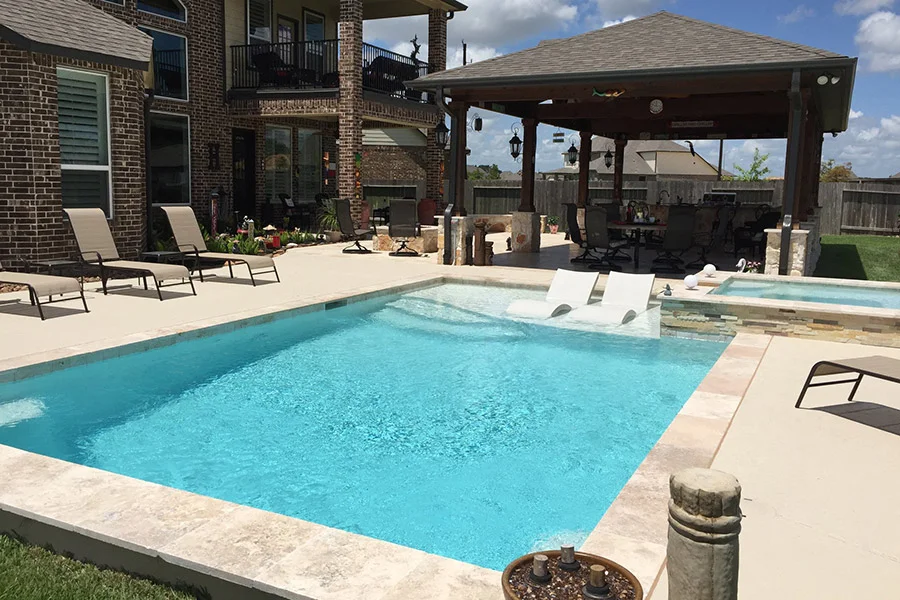
Your Guide to a Sparkling Clean Pool
To clean cartridge filter cartridges effectively, follow this simple process:
- Turn off the pump and release all pressure from the system
- Remove the cartridge from the filter housing
- Rinse thoroughly with a garden hose at a 45-degree angle
- Soak in cleaning solution (TSP or dishwasher detergent) for 3-6 hours if heavily soiled
- Rinse again, inspect for damage, and reinstall
Clean when pressure rises 8-10 PSI above your starting pressure, or every 3-6 months at minimum.
There’s something satisfying about seeing crystal-clear pool water on a sunny Houston afternoon. But keeping that water sparkling isn’t magic — it’s maintenance. And at the heart of that maintenance is your pool’s cartridge filter.
Your cartridge filter is working hard every single day, trapping dirt, oils, leaves, and all those tiny particles that can cloud up your water. Over time, all that debris builds up and clogs the filter pleats, making it harder for water to flow through. When that happens, your whole system works harder, your energy bills creep up, and your water clarity suffers.
The good news? Cleaning a cartridge filter is straightforward, doesn’t require fancy equipment, and takes less time than you’d think. Most pool owners can handle a basic cleaning in about 30 minutes, and a deep clean just requires a bit of soaking time.
In this guide, we’ll walk you through exactly how to clean your cartridge filter the right way — from knowing when it needs attention to the step-by-step process that’ll have it working like new again. We’ll also cover what tools you need, common mistakes to avoid, and when it’s time to replace the cartridge entirely.
Whether you’re a new pool owner or just want to get better at maintenance, this guide will help you keep your filter — and your pool — in top shape.
First Things First: Understanding Your Pool’s Cartridge Filter
A pool filter cartridge is like the lungs of your pool, constantly working to keep the water healthy and inviting. Imagine a large cylinder filled with a pleated element, usually made from reinforced polyester. As your pool pump circulates water, it draws dirty water into the filter. The pleated material then acts as a fine mesh, trapping debris, oils, and microscopic particles on its surface. Cleaner water then flows back into your pool, leaving the impurities behind.
This “surface filtering” method is incredibly efficient. Cartridge filters are known for their ability to capture very fine particles, typically between 10 and 20 microns. To give you some perspective, that’s significantly smaller than what a traditional sand filter can catch, which usually ranges from 20 to 40 microns. This superior filtration means your pool water in Houston and the surrounding areas will be noticeably clearer and more inviting.
Keeping your clean cartridge filter is incredibly important for several reasons. First, as the filter traps more and more debris, it becomes clogged. This reduces the water flow, which makes your pump work harder to push water through the system. A hardworking pump uses more energy, leading to higher electricity bills. More importantly, a clogged filter can’t do its job effectively, resulting in cloudy water and a less sanitary swimming environment. Regular cleaning extends the life of your filter cartridge and prevents unnecessary strain on your entire pool system, saving you money and headaches in the long run.
More info about our Custom Pools.
What Are the Telltale Signs a Filter Needs Cleaning?
Knowing when to clean cartridge filter is key to maintaining a healthy pool. While we recommend a routine cleaning schedule, your filter will often tell you when it’s ready for some attention.
The most reliable indicator is your filter’s pressure gauge. Every filter has a “starting pressure” or “clean pressure” when it’s freshly cleaned and operating optimally. You should always note this number. When your pressure gauge reads 8 to 10 PSI (pounds per square inch) higher than that starting pressure, it’s a clear sign that your cartridge is getting full of debris and needs cleaning. This increased pressure indicates that water is struggling to push through the clogged pleats.
Another obvious sign is cloudy pool water. If your water isn’t as crystal clear as it usually is, even after proper chemical balancing, a dirty filter is often the culprit. You might also notice reduced water flow from your return jets, which is another symptom of a struggling, clogged filter.
Beyond these signs, a good rule of thumb is to perform a basic rinse every 3 to 4 weeks during peak swimming season in our warm Texas climate. A more thorough deep clean is generally recommended every three months. However, if your pool experiences heavy use, or if there’s been a lot of rain, pollen, or landscaping debris, you might need to clean it more frequently. Some pool owners with oversized filters might find they can go longer between cleanings, but it’s always best to keep an eye on that pressure gauge!
Can You Just Backwash a Cartridge Filter?
This is a common question, and the answer for cartridge filters is a resounding no! Unlike sand or DE (diatomaceous earth) filters, cartridge filters are not designed to be backwashed. Backwashing involves reversing the water flow to flush out trapped debris, but this method isn’t suitable for the pleated material of a cartridge filter and wouldn’t effectively clean it. Cartridge filters require manual removal and cleaning.
While this might sound like more work, it actually offers some wonderful environmental benefits, especially important for us here in Texas where water conservation is always a consideration. Since you don’t backwash a cartridge filter, you save a significant amount of water that would otherwise be flushed away. This makes cartridge filters one of the most climate-friendly options available! Plus, they often perform well at slower pump speeds, which can lead to lower energy bills. It’s a win-win for your wallet and the environment.
Gearing Up: The Tools and Supplies You’ll Need
Before you dive into cleaning your cartridge filter, it’s always a good idea to gather all your tools and supplies. Having everything ready makes the process smoother and safer, letting you get back to enjoying your pool faster.
Here’s a list of what you’ll typically need:
- Garden Hose with a Multi-Function Spray Nozzle: A standard garden hose is essential. We recommend a nozzle that offers various spray patterns, like a “flat” setting, and ideally one that doesn’t require you to constantly hold down a lever. This allows for thorough rinsing without damaging the pleats.
- Large, Clean Bucket or Plastic Trash Can: Depending on the size and number of your filter cartridges, you’ll need something to soak them in. A 5-gallon bucket might work for smaller cartridges, but for larger ones, a 45-50 gallon plastic trash can is perfect. Make sure it’s clean and dedicated to pool maintenance.
- Commercial Filter Cleaning Solution (Optional): While there are many specialized products on the market, we find that some readily available household items are just as effective, if not more so, for a clean cartridge filter.
- Degreaser (Trisodium Phosphate or Dishwasher Detergent): This is your secret weapon against oils, lotions, and general grime.
- Trisodium Phosphate (TSP) powder: This is a powerful, old-school cleaner. Many “heavy-duty” cleaners still contain TSP or a substitute because it’s incredibly effective. Unicel, a major cartridge filter manufacturer, even officially endorses its use. You can find TSP at most hardware stores. Trisodium Phosphate (TSP) powder
- Powdered Dishwasher Detergent: If real TSP is hard to find or you prefer an alternative, powdered dishwasher detergent (the kind for machine washing, not hand washing) can work as a degreaser. It’s formulated to be low-foaming and often contains TSP substitutes. dishwasher detergent
- Muriatic Acid (for heavily soiled filters with mineral buildup): Also known as Hydrochloric Acid, this is a common pool maintenance product. It’s fantastic for cleaning off algae, iron, calcium carbonate (from calcium hypochlorite), or other mineral deposits. You’ll need about 1 to 2 gallons for a good soak. This is for advanced users and requires extra precautions. Muriatic Acid
- Safety Glasses: Absolutely essential when handling chemicals like muriatic acid. Your eyes are precious! safety glasses
- Chemical-Resistant Nitrile Gloves: Protect your hands, especially when working with cleaning solutions. Nitrile Gloves
- Silicone Paste: This is invaluable for reconditioning, lubricating, and sealing your O-rings and gaskets, especially if they’ve seen some wear from chlorine exposure. Make sure it’s a paste, not a grease. Silicone Paste
- Rubber Mallet: Handy for gently loosening a stuck filter housing retaining ring or clamp. Rubber Mallet
- Rags and/or Paper Towels: For general cleanup. Rags and/or Paper Towels
- 3/8″ Drive Ratchet and Torque Wrench (optional but recommended): To loosen and properly tighten the housing’s retainer ring bolt. A torque wrench ensures you get the right amount of pressure for a leak-free seal. 3/8″ Drive Ratchet and 3/8″ Drive Torque Wrench
- 19mm or 3/4″ Socket: For the retaining ring bolt. The size might vary slightly depending on your filter brand. 19mm or 3/4″ Socket
- Measuring Cup: For accurately dosing your cleaning chemicals. Measuring Cup
The Step-by-Step Guide to Clean Your Cartridge Filter
Ready to get that clean cartridge filter? Let’s walk through the process, step by step. Safety always comes first!
Step 1: Safety First—Power Down and Depressurize
Before you touch anything on your filter system, we need to make sure everything is turned off and depressurized. This is a crucial safety step to prevent accidental startups or pressure-related injuries.
- Turn off your pool pump: Locate the switch for your pool pump and turn it to the “off” position. If your pump runs on an automatic timer, make sure to disengage it or put your automation system into service mode.
- Shut off power at the breaker: For an extra layer of safety, head to your electrical panel and switch off the breaker that controls your pool equipment. This ensures no electricity can reach the pump while you’re working.
- Close inlet and outlet valves (if applicable): If your system has isolation valves on the pipes leading into and out of the filter, close them now.
- Open the air relief valve: This is usually a small valve or knob located on the top of your filter tank. Slowly open it to release any trapped air and pressure from inside the filter. You’ll hear a hissing sound as air escapes. Wait until the sound stops and water begins to trickle out, indicating all pressure has been relieved.
Watch our video on how to safely clean a Clean & Clear Plus Filter.
Step 2: Open the Housing and Remove the Cartridge
With the power off and pressure relieved, it’s time to open up the filter housing and get to those cartridges.
- Locate and loosen the locking ring/clamp: Most cartridge filters have a large clamp or locking ring that holds the top and bottom halves of the filter tank together. Use your socket and ratchet to loosen the bolt on this clamp. You’ll typically need a 19mm or 3/4″ socket. If the clamp is a bit stubborn, a gentle tap with a rubber mallet might help loosen it.
- Remove the top housing: Once the clamp is removed, carefully lift off the top half of the filter tank. Be prepared for some water to spill out as you do this.
- Lift out the cartridge(s): Inside, you’ll see your filter cartridge(s). Gently lift them straight up and out of the tank. Sometimes a slight rocking motion can help if they’re snug.
- Inspect the O-ring: Before setting the top housing aside, take a moment to inspect the large O-ring that seals the two halves of the tank. Check for any cracks, tears, or flattening. We’ll address this in a later step.
Step 3: The Initial Rinse—How to Properly Clean a Cartridge Filter
This is where the magic of a clean cartridge filter begins! A thorough initial rinse will remove the bulk of the debris.
- Grab your garden hose: Use your garden hose with a multi-function spray nozzle. We find that a “flat” or “jet” setting works best.
- Rinse from top to bottom at an angle: Hold the cartridge at a slight angle (around 45 degrees) and spray water down into the pleats, working from the top to the bottom. The goal is to flush the debris out from between the pleats.
- Work your way around: Rotate the cartridge, systematically spraying each section of pleats until all visible debris is gone. You might need to gently separate some pleats with your fingers to ensure you reach all the hidden grime.
- Avoid high-pressure washers: While it might seem tempting to use a pressure washer for a quicker clean, please resist! The high pressure can damage the delicate filter material, tearing the pleats or breaking the internal bands, which will shorten the life of your cartridge. Moderate water pressure from a garden hose is all you need.
- Pro tip for water conservation: As good neighbors in Houston, we’re always looking for ways to save water. Instead of hosing the filter over a drain, direct the water over soil or grass. The debris from your pool is usually organic, making it perfectly safe and even beneficial for your plants or lawn! @theaussiepoolguy: Pro tip: To save water, hose the filter over soil or grass instead of a drain. This allows it to feed your plants or lawn instead of being wasted. Also, pool water debris is usually organic, so it’s perfectly safe to put it in your soil. Check out this quick demonstration from@theaussiepoolguy:.
Step 4: The Deep Clean for Greasy, Grimy Filters
For filters that are heavily soiled with body oils, suntan lotions, or stubborn mineral deposits, a simple rinse won’t be enough. This step is where we give your cartridge a spa day of its own!
- Prepare your soaking solution:
- For degreasing (oils, lotions, general grime): Fill your large bucket or plastic trash can with water. Add about 1 cup of Trisodium Phosphate (TSP) powder or powdered dishwasher detergent for every 5 gallons of water. Stir well to dissolve the powder.
- For mineral buildup (algae, iron, calcium carbonate): If you notice a white, tan, or orange coating that won’t rinse off, you likely have mineral buildup. For this, you’ll need a muriatic acid bath. Always wear your nitrile gloves and safety glasses when handling muriatic acid. In a separate plastic container (never metal), mix 1 part muriatic acid to 20 parts water. Always add acid to water, never water to acid, to prevent splashing and dangerous reactions. It’s important to do the degreasing step before the acid wash, as oils can prevent the acid from working effectively and create a cement-like mass.
- Submerge your cartridge: Carefully place your rinsed filter cartridge(s) into the chosen soaking solution, ensuring they are completely submerged.
- Soak for the recommended time:
- Degreasing solution: Let the cartridges soak for at least 3 to 6 hours, or ideally, overnight. The longer they soak, the more effectively the solution will break down the oils and grime.
- Muriatic acid solution: If using the acid bath, leave the filters in until the bubbling stops (if present), which typically indicates the reaction with the minerals has completed. This could be 20 minutes or several hours, depending on the severity of the buildup.
- Rinse thoroughly after soaking: Once the soaking is complete, remove the cartridges and give them another thorough rinse with your garden hose. Make sure to flush out all traces of the cleaning solution from the pleats. For the muriatic acid solution, you can neutralize it with baking soda or ammonia before disposing of it according to local regulations.
Step 5: Reassembly and a Fresh Start
You’re almost there! With your clean cartridge filter ready, it’s time to put everything back together and get your pool sparkling again.
- Inspect cartridge for damage: Before reinstalling, take a final look at your clean cartridge. Check for any tears in the pleats, cracked end caps, or broken bands. If you find significant damage, it might be time for a replacement (we’ll cover that next).
- Clean the filter tank interior: While the cartridges were soaking, you can use that time to wipe down the inside of your filter tank, removing any accumulated dirt or debris.
- Lubricate the O-ring: Large O-ring you inspected earlier? If it’s in good condition, clean it thoroughly and apply a thin layer of silicone paste. This helps create a better seal, prevents leaks, and prolongs the O-ring’s life.
- Reinstall the cartridge(s): Carefully place the clean cartridge(s) back into the filter tank, ensuring they are properly seated.
- Secure the lid: Place the top half of the filter tank back on, aligning it carefully. Reinstall the locking ring or clamp, making sure it’s positioned correctly.
- Tighten the clamp: Use your ratchet and socket to tighten the clamp bolt. If you have a torque wrench, we recommend using it to tighten the bolt to the manufacturer’s specified torque (for example, some Hayward filters recommend 150 inches-lbs). This ensures a secure, leak-free seal without overtightening.
- Open valves and refill pool (if necessary): Open any inlet and outlet valves you closed in Step 1. If your pool water level dropped during this process, make sure to refill it to the proper operating level.
- Turn pump on and bleed air: With everything secure, turn the power back on at the breaker and start your pool pump. Immediately open the air relief valve on the top of your filter again. You’ll hear air escaping, followed by a steady stream of water. Once you have a steady stream of water, close the air relief valve. This purges any trapped air from the system.
- Note the new, clean pressure reading: Your pool is now circulating with a sparkling clean cartridge filter! Take note of the new, lower pressure reading on your gauge. This is your new “clean pressure” baseline for future reference.
Knowing When It’s Time for a Replacement
Even with the best cleaning and maintenance, every good thing eventually comes to an end. Cartridge filters are no exception. With proper care, most pool filter cartridges can last between three to five years. However, there are definite signs that indicate it’s time to say goodbye to your old cartridge and welcome a new one.
Here are the telltale signs your cartridge filter needs to be replaced:
- Persistently High Pressure After Cleaning: If you’ve given your cartridge a thorough cleaning, even a deep soak, and the pressure gauge still reads significantly higher than your baseline clean pressure (e.g., still around 6 PSI above it), it means the filter media is permanently clogged or compromised. The pleats may be too flattened or caked with microscopic debris that can no longer be removed.
- Cracked End Caps: The top and bottom plastic caps of the cartridge can crack over time due especially to chemical exposure or age. Cracked end caps mean water can bypass the filter media entirely, rendering it ineffective.
- Torn or Flattened Pleats: Inspect the pleated material carefully. If you see any tears, rips, or if the pleats are permanently flattened and no longer spring back, the filter is no longer doing its job. Flattened pleats reduce the effective surface area for filtration.
- Broken Bands: Many cartridges have horizontal bands that help hold the pleats in place. If these bands are broken, the pleats can spread apart, creating channels for unfiltered water to pass through.
- Fuzzy or Deteriorated Fabric: Over years of use and chemical exposure, the filter fabric itself can start to look fuzzy, brittle, or simply deteriorated. This indicates the material is breaking down and losing its filtration capability.
Replacing a worn-out filter cartridge is an investment in your pool’s clarity and the efficiency of your entire system. It helps maintain water quality, reduces strain on your pump, and ensures your pool is always ready for a refreshing dip.
Frequently Asked Questions about Cleaning Cartridge Filters
We often hear some great questions about keeping cartridge filters sparkling. Here are a few of the most common ones:
How long does it take to clean a pool filter cartridge?
A quick rinse with a garden hose to remove loose debris typically takes about 20 to 30 minutes of hands-on time. If your filter requires a deep clean with soaking in a chemical solution, the actual soaking time can be several hours (often overnight). However, this is mostly hands-off time, allowing you to attend to other tasks around your home in Houston while the solution works its magic!
How does a clean cartridge filter impact my pool’s health and costs?
A clean cartridge filter has a huge positive impact on both your pool’s health and your wallet. When your filter is clean, water flows easily through the system. This means your pool pump doesn’t have to work as hard, which directly translates to lower energy consumption and reduced electricity bills. A clean filter also ensures superior water clarity, effectively removing contaminants and keeping your pool water balanced and healthy. Less strain on your pump and other equipment means they’ll last longer, reducing repair and replacement costs over time. It’s truly one of the simplest ways to optimize your pool’s performance and save money!
How often should I replace my pool filter cartridge?
With consistent and proper maintenance, including regular rinsing and periodic deep cleaning, most pool filter cartridges will last between three to five years. However, replace your cartridge sooner if you notice any signs of damage, such as tears in the pleated fabric, cracked plastic end caps, or broken bands. If your pool water isn’t clearing up even after a thorough cleaning, that’s another strong indication it’s time for a new cartridge.
Keep Your Pool Shining Bright
Regular filter cleaning is one of the simplest ways to ensure your pool water stays inviting and clear all season long. By following these steps, you can keep your filtration system running smoothly and efficiently. At Ocean Blue Pools, we know that a well-maintained pool is a happy pool, giving you more time to make memories with family and friends. If your backyard oasis needs more than just a filter cleaning to get it back to its former glory, our team is here to help you transform your space. Explore our Pool Remodeling services and let’s bring your vision to life.