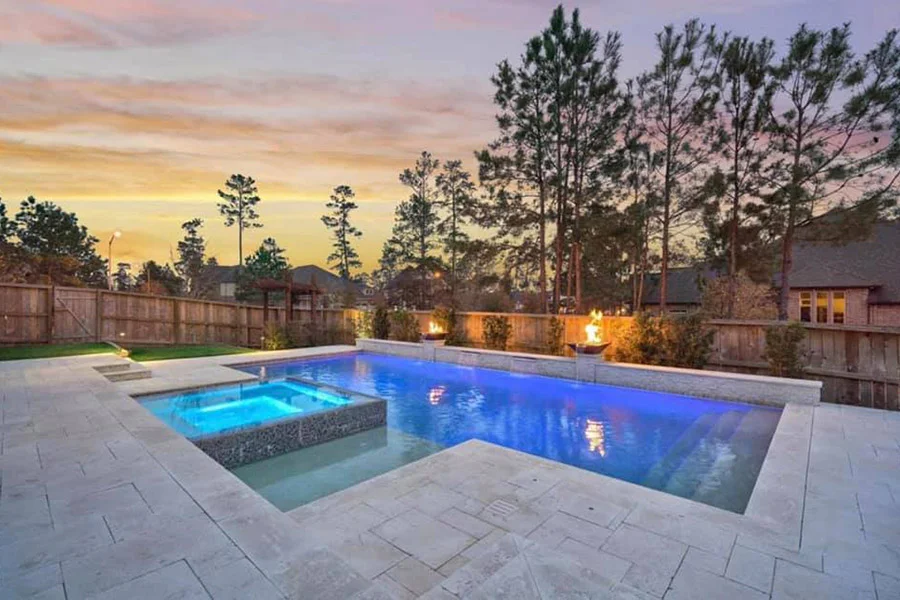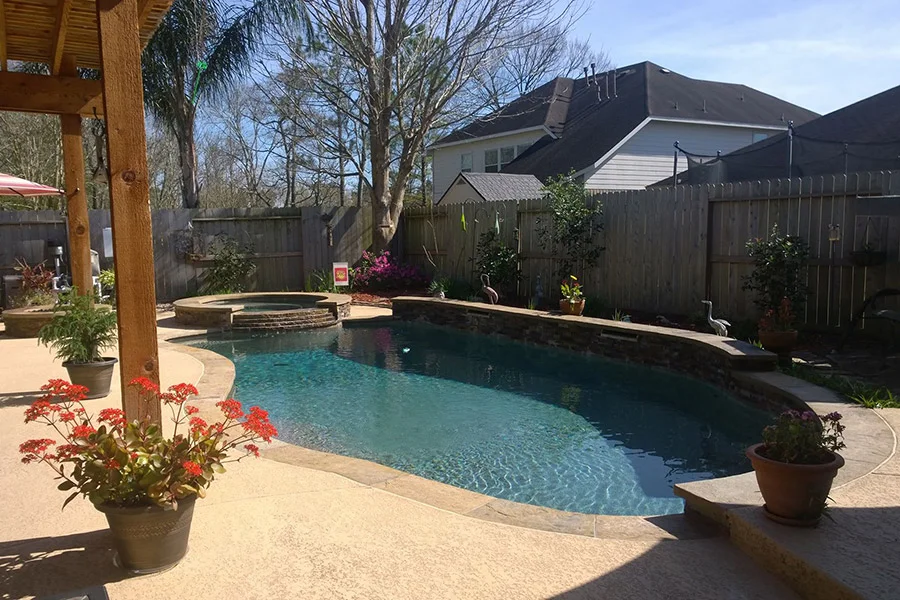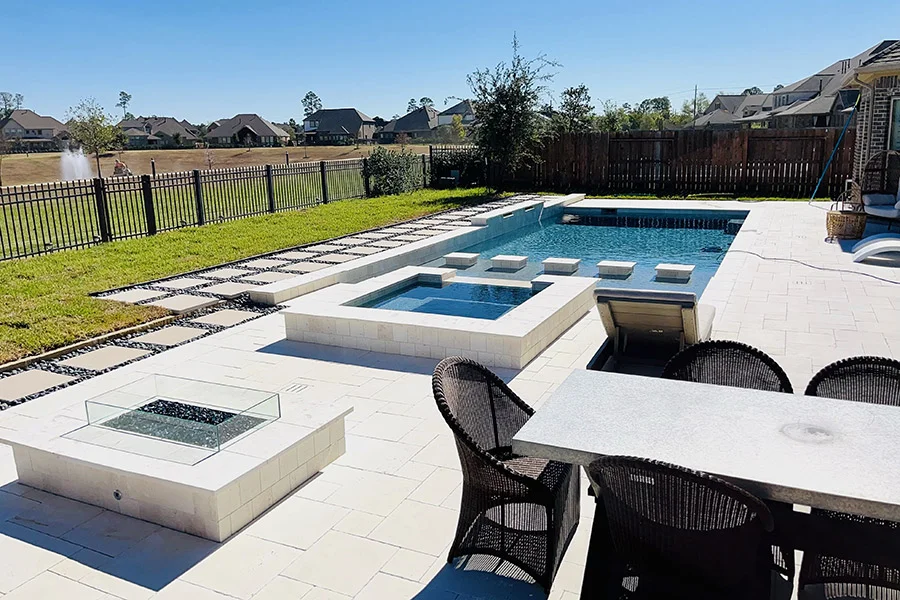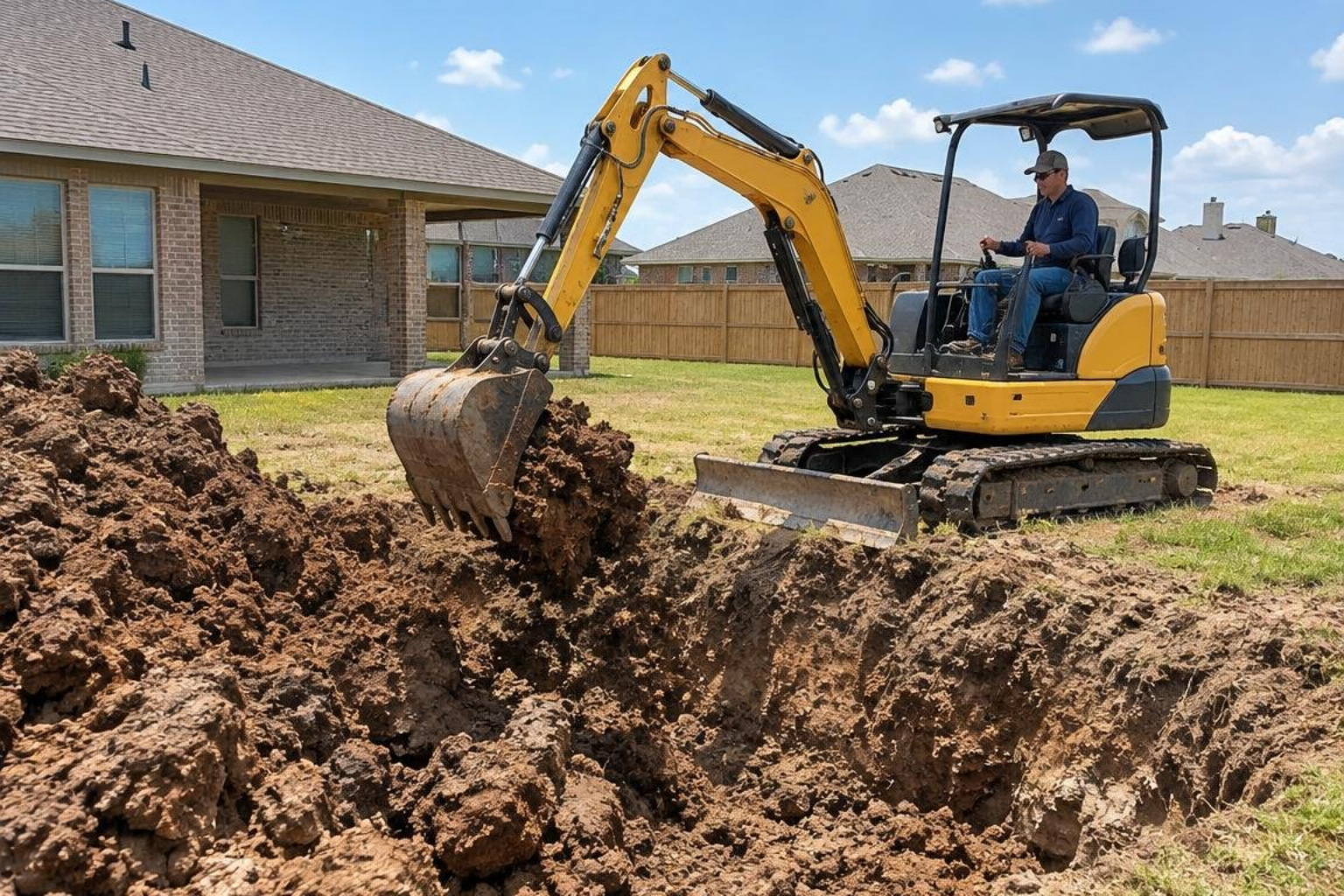
The pool design that stops everyone in their tracks
Perimeter overflow pools are one of the most striking things you can build in a backyard. Water runs flush with the deck on all four sides, spilling silently into a hidden gutter — creating a mirror-like surface that looks almost too perfect to be real.
If you’re exploring modern pool design trends, here’s what you need to know at a glance:
- What they are: Pools where water continuously overflows every edge into a concealed gutter, creating a seamless, reflective surface flush with the surrounding deck.
- Also called: Rim-flow, zero-edge, knife-edge, wet-edge, or slot-overflow pools.
- How they differ from infinity pools: Infinity pools overflow on one side only. Perimeter overflow pools overflow on all four sides — a more immersive effect, and a bigger engineering challenge.
- Best for: Flat lots (like most Houston backyards), modern and minimalist designs, and homeowners who want the ultimate in luxury and visual impact.
- Cost range: $150,000–$500,000+, depending on size, materials, and complexity.
- Key requirement: The entire pool edge must be level to within 1/32 of an inch for even water flow.
It’s a design that turns heads and transforms an ordinary backyard into something that feels closer to a five-star resort. But it’s also one of the most technically demanding pools you can build — and getting the details right matters a lot.
At Ocean Blue Pools, we’ve spent over 25 years helping Houston homeowners build pools they’re genuinely proud of. In this guide, we’ll walk you through everything — how these pools work, what they cost, what can go wrong, and whether one might be right for your family.
Key terms for perimeter overflow pools:
What are perimeter overflow pools and how do they work?

To understand why these pools look so incredible, you have to look at how they handle the water level. In a standard swimming pool, the water sits about six inches below the edge of the deck, and you can see the plastic skimmer faces along the tile line.
With perimeter overflow pools, the water is filled right to the very top. It spills continuously over all four edges, making the pool look like a solid sheet of glass or a perfectly still mirror. This elegant feature is why they are a favorite in modern Luxurious Pool Designs.
Because the water is constantly spilling over the edge, it is caught in a hidden, narrow slot or gutter built directly into the surrounding deck. This constant skimming action on all sides keeps the surface of your pool incredibly clean, as leaves, dust, and oils are swept away before they can sink.
The mechanics behind perimeter overflow pools
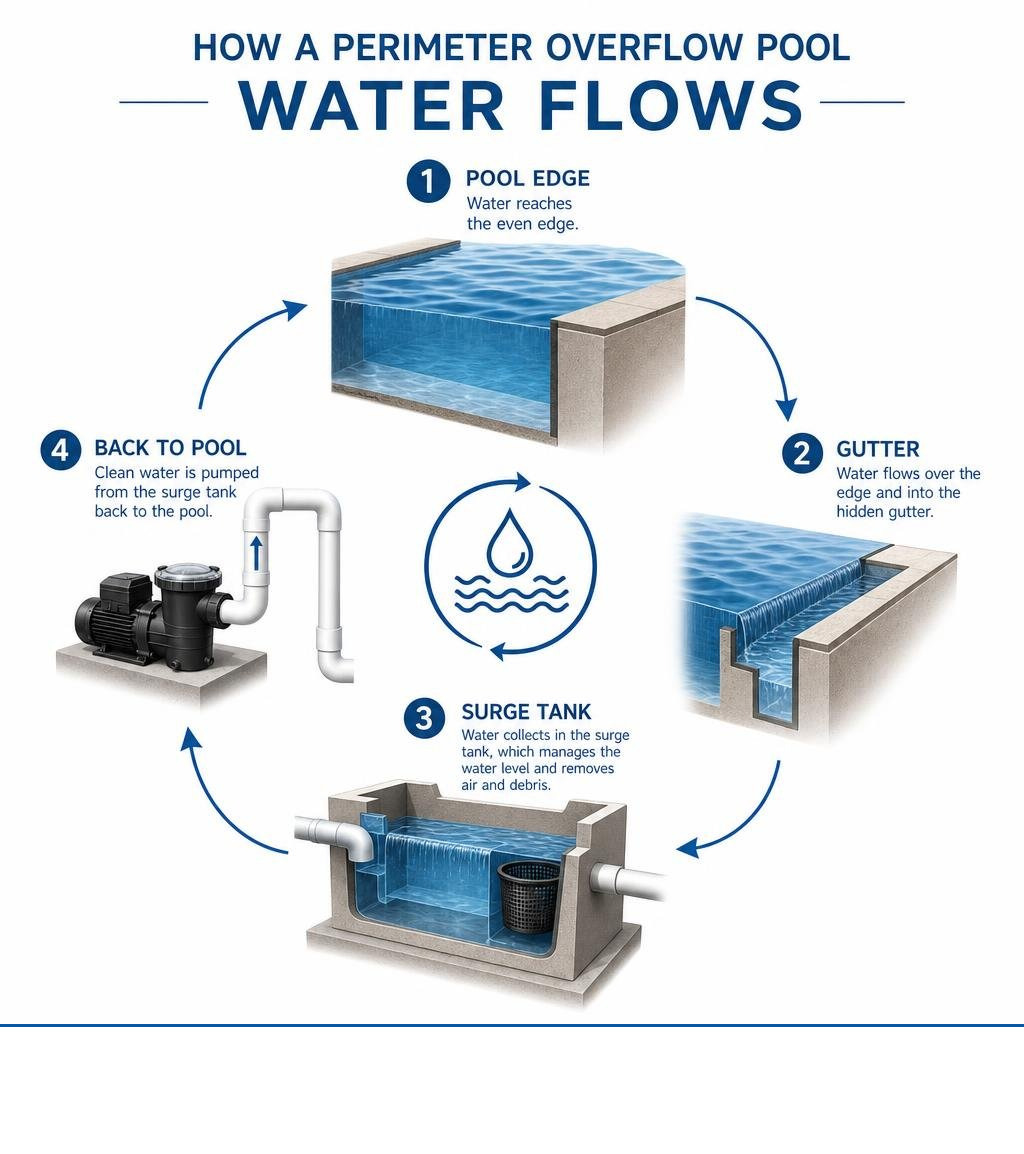
While the visual effect is peaceful, there is a lot of heavy lifting happening just beneath the surface. The system relies on a continuous loop of water-in-transit:
- The Overflow: Water spills over the pool’s level edge (the weir).
- The Collector Gutter: A narrow channel hidden under the deck coping catches the overflowing water.
- The Gravity Drain: The water flows by gravity out of the channel and into a remote holding tank.
- The Surge Tank (or Compensation Tank): This tank is the brains of the operation. It sits below the level of the pool and stores the displaced water. When people jump into the pool, they displace water. The surge tank holds this extra volume so it doesn’t flood your yard.
- The Filtration & Return System: A high-performance circulation pump draws water from the surge tank, pushes it through the filter and heater, and sends it back into the pool through return inlets, usually located on the pool floor to help push debris upward and outward.
Perimeter overflow pools vs. infinity edge designs
People often confuse these two styles, but they are actually very different animals.
An infinity-edge pool is designed for properties with a view and a slope. It overflows on just one side, spilling down into a visible catch basin below, creating the illusion that the water is merging with the horizon. You can read more about how those work in our guide on Infinity Edge Pool Design.
A perimeter overflow pool is designed for flat terrain — which is exactly what we have here in the Houston area, from Katy to The Woodlands. It overflows on all four sides, allowing the pool to integrate seamlessly with a flat deck.
| Feature | Perimeter Overflow Pool | Infinity Edge Pool |
|---|---|---|
| Overflow Sides | All 4 sides (360 degrees) | Usually 1 side |
| Visual Effect | Mirror-like, flat sheet of glass | Vanishing horizon, waterfall |
| Best Terrain | Flat yards | Sloped yards or drop-offs |
| Surge Tank | Required (usually hidden underground) | Catch basin acts as the tank |
| Water Level | Flush with the surrounding deck | Below the deck on non-overflow sides |
Engineering and design requirements for flawless execution
Building a pool like this is not a project for a beginner. It requires absolute precision from start to finish.
The single most important factor is the level of the pool wall. To get that perfect, uniform sheet of water spilling over all four sides, the entire perimeter must be level within a tolerance of 1/32 of an inch. If one corner is off by even a quarter of an inch, the water will only spill out of the low side, leaving the high side dry and ruining the entire visual effect.
To achieve this, our crews use high-precision laser levels during the concrete pour and the tile installation. We also build a wider, heavily reinforced concrete bond beam (usually 20 to 24 inches wide) to house the integrated gutter, plumbing lines, and structural steel. This prevents any shifting or settling over time, which is especially important in our shifting Houston clay soils. If you want to learn more about how we plan these structures, check out our article on Architectural Pool Design.
Hydraulic systems and surge storage capacity
The plumbing for these pools is highly specialized. Because the water flows via gravity from the gutter to the surge tank, the plumbing lines must be oversized (often 3-inch or 4-inch pipes) and properly vented with snorkel lines to prevent gurgling or sucking noises. Nobody wants a luxury pool that sounds like a running toilet!
The surge tank itself must be carefully calculated. Under standard building guidelines, such as the Perimeter Overflow Systems | UpCodes standards, a perimeter overflow system needs a minimum surge storage capacity of 1 gallon per square foot of pool water surface area.
Additionally, the overflow channel itself must be at least 3 inches deep and 3 inches wide at the bottom, with the channel lip sitting no more than 12 inches below the deck level. This ensures the system can handle heavy rain and the splash-out from a family pool party without running dry or overflowing.
Selecting the right materials and finishes
Because the water flows directly over the edge of the pool and onto the deck area, your choice of materials is highly important.
For the visible edge itself, we often recommend high-quality, dense materials like granite tile, basalt, or precast concrete coping. These materials can be ground and polished to a razor-sharp, perfectly level edge. Large-format porcelain pavers are also excellent for the surrounding deck because they are incredibly durable, slip-resistant, and won’t warp.
To get the best mirror reflection, we recommend choosing a darker interior plaster finish, such as a deep gray or black onyx. A dark plaster makes the bottom of the pool disappear visually, turning the water surface into a highly reflective mirror that bounces the Texas sky and your backyard lighting beautifully. You can read more about choosing these details in our A Guide to Choosing the Right Aesthetic Features for a Custom Pool.
Finally, we apply redundant waterproofing layers to the concrete shell and the gutter system. We use advanced concrete additives like Xypex alongside specialized surface membranes to ensure that not a single drop of water leaks into the surrounding ground.
Common construction mistakes to avoid
Because perimeter overflow systems are so complex, there are several common mistakes that inexperienced builders make. When we design these projects, we take extra care to avoid these pitfalls:
- Improper backflow prevention: When the pool pump turns off, gravity wants to pull all the water in the plumbing lines back down into the surge tank. If your builder doesn’t install proper check valves or air-gap systems, the surge tank will overflow every time the pump stops.
- Uneven edge tolerances: As mentioned, even a tiny deviation in the edge level will stop the water from flowing evenly.
- Undersized plumbing and noise: If the gravity return lines are too small, they will create a vacuum and make loud, annoying gurgling noises.
- Poor deck drainage: The deck surrounding the pool must be sloped slightly away from the overflow slot. If it is sloped toward the slot, dirty rainwater and lawn fertilizers will wash directly into your pool water.
Building a pool of this caliber requires a team that understands structural engineering inside and out. For a deeper look at how we plan these builds, see our A Practical Guide to Custom Pool Design.
Cost, maintenance, and family suitability
Let’s talk honestly about what it takes to own one of these beautiful pools.
Because of the extreme engineering, extra concrete, specialized plumbing, and the addition of a surge tank, perimeter overflow pools are a significant investment. A basic perimeter overflow pool typically starts around $150,000 to $250,000, while high-end, fully custom designs can easily reach $300,000 to $500,000 or more.
They also require a bit more attention than a standard pool. While the continuous 360-degree skimming keeps the pool surface pristine, you do have to maintain the hidden components. The perimeter gutters need to be cleared of leaves and debris, and the underground surge tank must be professionally serviced — typically drained, rinsed, and vacuumed out — at least twice a year to prevent dirt and bacteria buildup.
If you want to read more about general pool ownership, check out our comprehensive guide on Everything You Need to Know About Inground Swimming Pools.
Frequently Asked Questions about perimeter overflow systems
Are perimeter overflow pools safe for families with children?
Yes, they are perfectly safe. The overflow slot is typically only about an inch wide, meaning little feet and hands cannot get stuck in it. However, because the water is flush with the deck, there is no raised coping to act as a physical barrier. Children should always be supervised, and we highly recommend installing safety covers, alarms, and shallow steps to make the pool easy to exit.
How often does the surge tank need to be cleaned?
We recommend servicing the surge tank twice a year. Over time, fine dust and small debris that slip through the gutter grates will settle at the bottom of the tank. Cleaning it out prevents this debris from clouding your water or clogging your filtration system.
Can you build a perimeter overflow pool on flat Houston ground?
Absolutely! In fact, flat ground is the ideal setting for a deck-level perimeter overflow pool. Because we don’t have to deal with steep slopes, we can focus on creating a seamless, flush transition from your living room floor right out to the water’s edge.
Bring your dream backyard to life
A perimeter overflow pool is more than just a place to swim — it is a piece of living architecture that completely transforms your home.
At Ocean Blue Pools, we’ve spent more than 25 years building custom pools in Houston, Katy, Sugar Land, Cypress, and the surrounding areas. We pride ourselves on honest pricing, clear communication, and the kind of precise craftsmanship that a high-end pool like this demands.
Let’s build something beautiful together. Schedule your free consultation with our design team today.