Why the Gunite Curing Process Determines How Strong Your Pool Will Be
The gunite curing process is the most important step in building a pool that lasts — and it’s the one homeowners ask about most once the shell goes in.
Here’s the short answer:
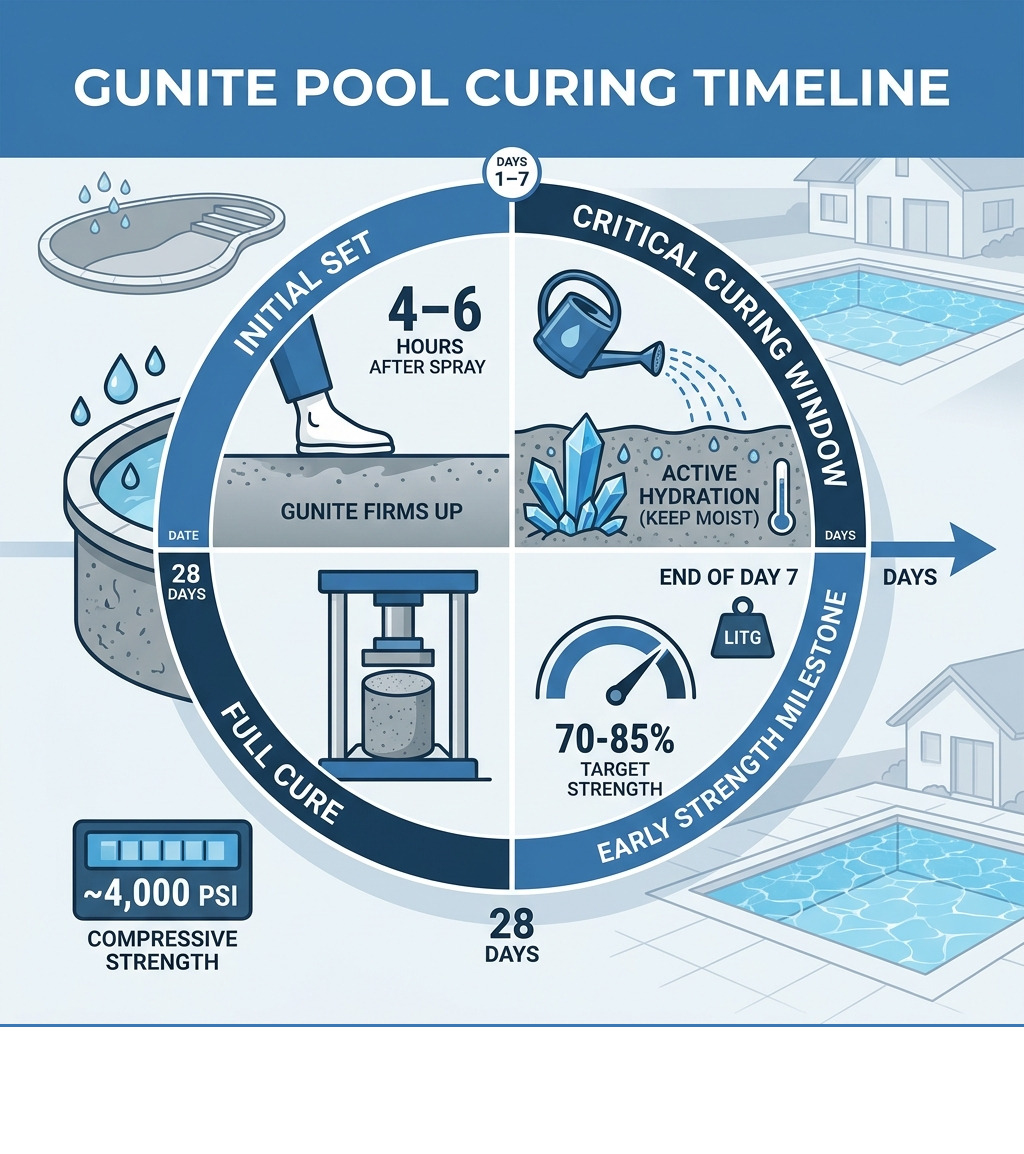
| Stage | Timeframe | What’s Happening |
|---|---|---|
| Initial set | 4–6 hours after spray | Gunite firms up enough to walk near |
| Critical curing window | Days 1–7 | Hydration is most active; keep it moist |
| Early strength milestone | End of Day 7 | Reaches 70–85% of target strength |
| Full cure | 28 days | Reaches optimal compressive strength (~4,000 PSI) |
The chemical reaction that turns gunite into rock-hard concrete takes up to 28 days to fully complete. Rush it, and you risk cracks, leaks, and a shell that won’t hold up over time.
Most Houston-area homeowners are excited to get to the fun parts — tile, plaster, water. That’s completely understandable. But here’s the thing: what happens in those first few weeks after the gunite goes in quietly determines how your pool performs for the next 30 to 50 years.
Proper watering, the right timing, and a little patience aren’t just good habits — they’re what separates a pool that holds up through Houston summers from one that gives you problems down the road.
This guide walks you through exactly what’s happening during the cure, what you need to do (and avoid), and when it’s safe to move forward with the next phase of your build.
Basic gunite curing process glossary:
Understanding the Gunite Curing Process
When we talk about the gunite curing process, we aren’t just talking about the concrete “drying out.” In fact, drying out is exactly what we want to avoid! Curing is a chemical reaction called hydration. When the dry mix of cement and sand meets water at the nozzle of the spray gun, a chemical bond begins to form.
This reaction is “exothermic,” which is just a fancy way of saying it creates its own heat. If you were to put your hand near a freshly sprayed gunite shell, you might actually feel the warmth radiating off it. This heat is a sign that the cement is working hard to bind everything together into a solid, stony structure.
If the water inside the mix evaporates too quickly because of our Texas sun, the chemical reaction stops. When that happens, the gunite doesn’t reach its full strength, leading to a shell that is brittle and prone to shrinking. By keeping the surface moist, we ensure that the hydration continues until the shell reaches its maximum structural integrity. You can learn more about these technical standards through Shotcrete and Gunite Applications.
Gunite vs. Shotcrete: What’s the Difference?
We often hear folks use these terms interchangeably, but there is a distinct difference in how they are mixed and applied.
- Gunite (Dry-Mix): This is our preferred method for custom pools in the Houston area. The cement and sand are mixed dry, then blown through a hose using compressed air. The water is added right at the nozzle by the “nozzleman.” This gives us incredible control over the water-to-cement ratio, which is vital for creating those beautiful, complex curves and custom steps our clients love.
- Shotcrete (Wet-Mix): This is concrete that is already mixed with water before it ever enters the hose. While it works well for large, flat structural projects, it doesn’t always offer the same level of artisan control that gunite does for a backyard oasis.
Because gunite is applied at such high velocity, it compacts itself upon impact, creating a very dense material with a high compressive strength. For a deeper dive into the mechanics, check out Gunite/ Guniting : Everything You Need to Know.
Why Moisture is Key for Strength
The goal for a high-quality pool shell is to reach a compressive strength of approximately 4,000 PSI (pounds per square inch). Some properly compacted and cured shells can even reach up to 6,000 PSI!
To get there, the American Shotcrete Association recommends a minimum of seven days of continuous wet curing. This isn’t just a suggestion; it’s a standard for controlling shrinkage. When concrete cures, it naturally wants to shrink a little bit. If it shrinks too fast because it’s dry, it pulls apart and creates cracks. Keeping it wet keeps the temperature down and the material stable.
The 28-Day Timeline: How Long Does It Really Take?
While the first week is the most active, the gunite curing process officially spans 28 days. This is the industry standard for when concrete is considered to have reached its “design strength.”
Here is how that timeline generally breaks down:
- Day 1: The shell is “green.” It looks solid but is still chemically very active.
- Day 7: With proper watering, the gunite should reach about 70% to 85% of its 4,000 PSI target. This is a big milestone!
- Day 28: The hydration process has slowed down significantly, and the shell is now at its peak strength, ready for the final finishes.
It is helpful to remember that gunite actually continues to cure and get stronger for years, but the first 28 days are where the heavy lifting happens. For more details on this timeline, you can refer to How Long for a Gunite Pool to Cure?.
Factors Influencing Your Gunite Curing Process
In Greater Houston—from Katy to The Woodlands—our weather plays a huge role in how your pool cures.
- Humidity: High humidity (which we have plenty of!) is actually a friend to the curing process because it slows down evaporation.
- Ambient Temperature: On those 100-degree August days, the water we spray on the shell evaporates almost instantly. During these times, you’ll need to water the shell more frequently to keep it from “cooking.”
- Pool Design: A large pool with many custom features like Baja shelves or raised spas has more surface area that needs attention compared to a simple rectangular design.
Planning for these variables is a big part of How to Plan a Pool Installation: Tips for Homeowners.
When Can You Walk on the Shell?
We know you’re dying to walk down those new steps and imagine the water, but patience is a virtue here.
- First 4–6 Hours: Stay off the shell entirely. It’s still setting.
- After 24 Hours: You can typically walk on the floor of the pool shell, but we recommend being very “ginger” about it. Avoid wearing heavy boots or twisting your feet.
- First 3 Days: We generally advise against walking on the steps or sharp benches, as these edges are the most vulnerable to chipping before they harden.
Step-by-Step Guide to Watering Your Pool Shell
Watering your pool shell is your main job as a homeowner during this phase, and it’s a great way to feel involved in the “birth” of your pool. Think of it like taking care of a new garden.
- Wait 24 Hours: You don’t need to start watering the second the crew leaves. Give it about a day to achieve its initial set.
- Frequency: Aim for 2 to 5 times daily. In the cooler months (if we have them!), twice a day is usually plenty. In the peak of summer, you might be out there 5 times.
- The Technique: Use a garden hose with a spray nozzle set to a “mist” or “shower” setting. You want to soak the shell until the water runs off and puddles slightly at the bottom, but you don’t want to hit it with a high-pressure jet stream.
- Saturated Surface Dry (SSD): This is the goal. You want the gunite to look dark and damp. If it starts looking light grey and chalky, it’s thirsty!
For a classic how-to on this, How To Cure Gunite For Pools offers some great additional tips.
Best Practices for Houston Weather
Living in places like Richmond, Fulshear, or Sugar Land means dealing with intense sun.
- Morning is Best: Start your first watering early in the morning before the sun starts beating down on the concrete.
- Avoid Thermal Shock: This is a big one. If the gunite has been sitting in 100-degree sun all day and is scorching hot, don’t blast it with ice-cold water suddenly. This can cause “thermal shock,” leading to tiny surface cracks. Instead, start by misting the air around it or starting at the bottom and working your way up slowly.
- Summer Adjustments: If you’re at work all day, consider setting up a simple oscillating sprinkler on a timer in the bottom of the pool. It’s not a perfect substitute for hand-watering, but it helps maintain moisture.
We take these weather factors seriously at Ocean Blue Pools to ensure Quality Pool Construction regardless of the season.
Common Mistakes in the Gunite Curing Process
- The “Jet Stream”: Using a high-pressure power washer or a focused jet can actually pit the surface of the new gunite. Stick to the shower setting.
- Skipping Days: If you skip a day during the first week, you can’t “make it up” by watering twice as much the next day. The hydration window for that day has closed.
- Surface Crazing: This looks like a spiderweb of tiny cracks. It’s usually caused by the surface drying out too fast while the inside is still wet. While often just cosmetic, it’s a sign the shell needed more water.
- Rushing the Timeline: Trying to plaster the pool on Day 4 because the party is next weekend is a recipe for disaster. The plaster won’t bond correctly to a shell that hasn’t finished its initial shrink.
Moving to the Next Phase: Plaster and Tile
Once we hit that 7-to-14-day mark, things start to get exciting again. While the gunite curing process continues for 28 days, we can often begin some of the lighter masonry work after the first week of wet curing is complete.
Waterline tile and coping are usually the next guests at the party. However, if your design includes heavy features—like a massive rock grotto, large waterfalls, or heavy stone boulders—we often wait closer to the full 28 days. We want to make sure the “skeleton” of the pool is strong enough to support that extra weight without shifting.
To see how this fits into the bigger picture, read our guide on How to Survive the Stages of Inground Pool Installation.
Preparing for the Interior Finish
Before the plaster crew arrives, the shell needs a little “spa day” of its own. We will:
- Pump out excess water: All that water you’ve been spraying will collect in the deep end. We’ll get that out of there.
- Clean the shell: We remove any dirt, leaves, or “rebound” (loose sand that didn’t stick during the spray).
- Inspection: We do a final walkthrough to ensure the shell is perfect and ready to be sealed.
This is a key part of Our Process at Ocean Blue Pools. We don’t skip the small stuff.
Long-Term Durability and Maintenance
A properly cured gunite pool is a tank. It’s designed to withstand the shifting clay soils we have here in Harris and Montgomery counties. Because we use a heavy cage of #4 rebar, the gunite shell acts as a monolithic structure that moves (or resists moving) as one unit.
With good care and proper chemistry, a gunite pool can easily last 50 years or more. You may need to resurface the plaster every 10 to 15 years, but the gunite shell itself is a permanent addition to your home. For a local perspective on why this matters, check out our Gunite Pool Review Houston.
Frequently Asked Questions about Gunite Curing
What happens if it rains during the curing period?
In Houston, rain is just “free labor” for your curing process! If it rains, you can take the day off from watering. The natural humidity and rainwater are excellent for hydration. Just keep an eye on the pool afterward; if the rain washes a lot of silt or mud into the shell, we’ll need to clean that out before the next stage.
| Feature | Manual Watering | Rainfall |
|---|---|---|
| Consistency | You control the soak | Can be hit-or-miss |
| Coverage | Easy to hit the “high spots” | Great for soaking the floor |
| Effort | Requires 10–15 mins | Zero effort (thanks, Mother Nature!) |
Why does my gunite shell have small surface cracks?
Don’t panic! Tiny cracks, often called “crazing,” are very common. They are usually just on the very surface and don’t go through the structure. They happen because the very top layer of cement shrinks slightly faster than the concrete underneath. As long as they aren’t wide enough to stick a coin into, they are typically covered up perfectly by the plaster finish. If you see a larger crack, just give us a call and we’ll take a look.
Can I start the pool deck while the gunite cures?
We generally recommend waiting at least 14 days before bringing heavy machinery back into the yard for deck work. The vibrations from compacting the soil for a paver deck or the weight of a concrete truck can stress the pool shell while it’s still gaining its strength. It’s always better to play it safe. We discuss these timing nuances in How to Survive the Many Phases of Building a Pool.
Start Your Backyard Transformation
At Ocean Blue Pools, we’ve spent over 25 years building more than just pools—we build backyard destinations for families across Greater Houston. From the first dig in Fulshear to the final splash in Conroe, we pride ourselves on being the neighborly experts you can trust.
We know that the gunite curing process isn’t the most glamorous part of the build, but we treat it with the respect it deserves because we want your investment to last a lifetime. Our team handles every detail with Southern-friendly service and the precision of master craftsmen.
Are you ready to stop dreaming and start swimming? Let’s sit down and design a space that fits your life perfectly.
Build Your Dream Pool with Ocean Blue Pools today. Whether you are in Cypress, Tomball, or The Woodlands, we are ready to help you transform your backyard into something extraordinary.