What Happens When You Spray Gunite Into a Pool?
Spraying gunite pool is the phase where your backyard excavation truly becomes a swimming pool. A high-pressure hose shoots a dry cement-and-sand mix onto a steel rebar skeleton, with water added right at the nozzle. The result is a seamless, rock-solid shell — shaped exactly to your design.
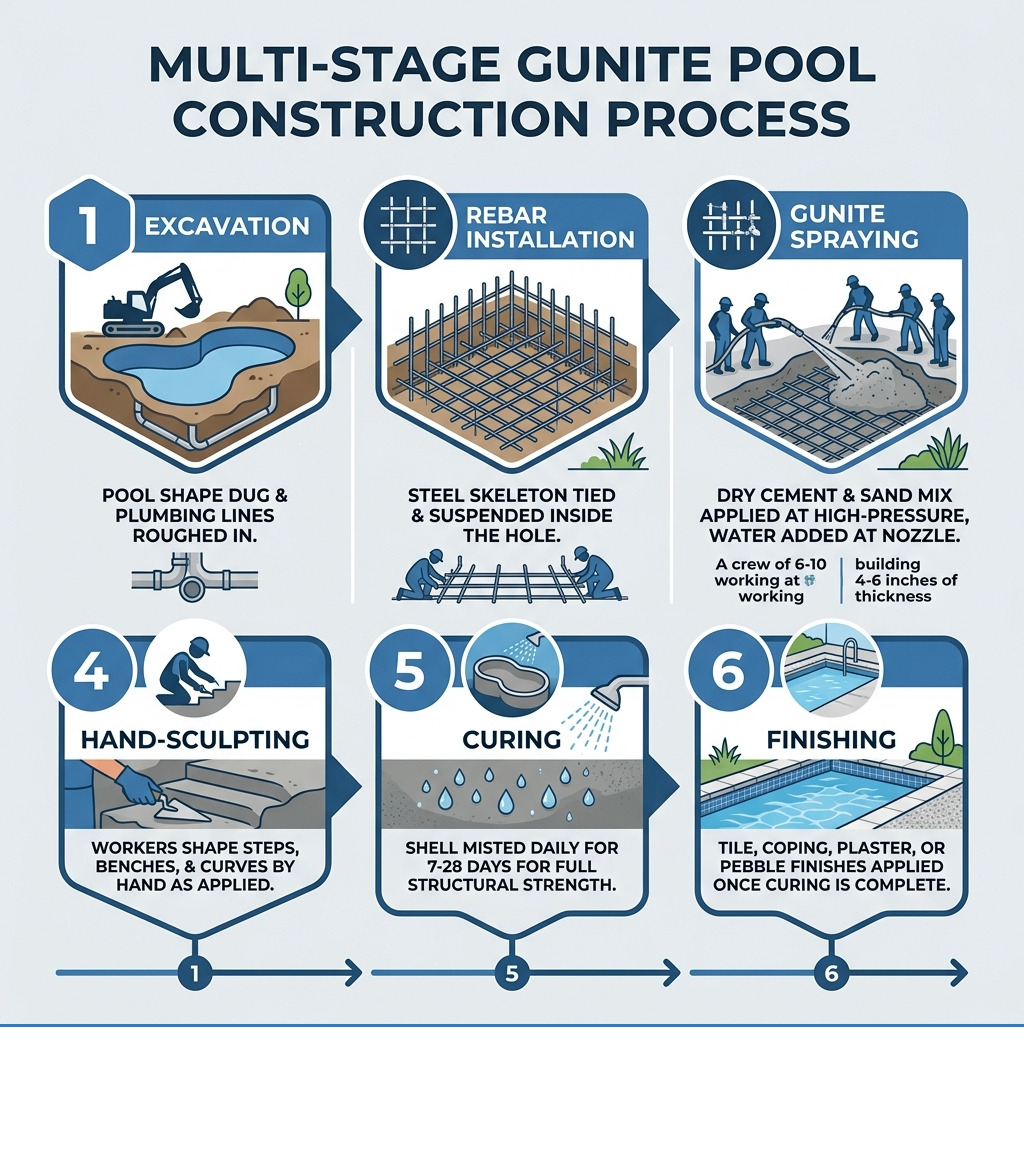
Here’s a quick look at how it works, start to finish:
- Excavation — The pool shape is dug out and plumbing lines are roughed in
- Rebar installation — A steel skeleton is tied and suspended inside the hole
- Gunite spraying — A crew of 6-10 applies the mix in a single day, building up 4-6 inches of thickness
- Hand-sculpting — Workers shape steps, benches, and curves by hand as the gunite is applied
- Curing — The shell is misted daily for 7-28 days to reach full structural strength
- Finishing — Tile, coping, plaster, or pebble finishes are applied once curing is complete
Most Houston homeowners never see this process coming — one day there’s a muddy hole in the backyard, and by evening there’s a real pool taking shape. It’s one of the most exciting days of the whole build.
What makes gunite the go-to choice for custom pools? It bonds seamlessly, handles soil movement, and can be sculpted into virtually any shape. That’s why it’s been the standard for high-quality inground pools since the 1950s.
This guide walks you through every stage of the gunite application process — from prep work to the final finish — so you know exactly what to expect.
Glossary for spraying gunite pool:
The Benefits of Spraying Gunite Pool for Houston Homes
When we talk about building a pool in Houston, we aren’t just building a place to swim; we’re building a permanent addition to your home. For over 25 years at Ocean Blue Pools, we’ve found that spraying gunite pool structures is the absolute gold standard for our neighbors in Harris and Fort Bend counties.
One of the biggest reasons gunite is so popular is its sheer versatility. Because gunite is sprayed rather than poured into a fixed mold, we can create any shape you can dream up. Whether you want a classic Roman-style pool or a free-form oasis that looks like a natural lagoon, gunite makes it possible. This Gunite Pool Info & Building Guide highlights that this flexibility is why you’ll see gunite at the world’s top resorts.
Beyond the “wow” factor, gunite is incredibly durable. A well-maintained gunite pool can last 50 years or more. From a financial perspective, a high-quality gunite pool can increase your property value by 5% to 7%, outperforming vinyl or fiberglass alternatives.
In our local Houston environment, the most important benefit is tensile strength. Our “Texas gumbo” soil is famous for expanding and shrinking. Gunite, reinforced with a heavy steel cage, provides the structural integrity needed to withstand that earth movement without cracking.
Gunite vs. Shotcrete and Traditional Concrete
You might hear the terms “gunite,” “shotcrete,” and “concrete” used interchangeably, but they aren’t exactly the same thing. Here is the breakdown:
- Traditional Concrete: This is poured into forms. Because it’s done in sections, it creates “seams” or joints. Over time, these joints are where a pool is most likely to leak or crack.
- Shotcrete: This is a “wet-mix.” The concrete and water are mixed at a plant and sent to your home in a mixer truck. It’s then pumped through a hose and shot out with air.
- Gunite: This is a “dry-mix.” The sand and cement stay dry until they reach the nozzle of the hose. The operator (the nozzleman) adds the water right as it’s being sprayed. This allows for much more precision and a stronger bond.
Because spraying gunite pool material happens at such high velocity, the mixture compacts itself upon impact. This creates a monolithic (one-piece) structure with no cold joints, making it the strongest way to build a pool shell.
| Feature | Gunite Pool | Fiberglass Pool | Vinyl Liner Pool |
|---|---|---|---|
| Lifespan | 50+ Years | 25+ Years | 10–15 Years |
| Customization | Unlimited | Limited to Molds | Moderate |
| Soil Movement | Excellent Resistance | Good | Low |
| Build Time | 3–6 Months | 3–6 Weeks | 4–8 Weeks |
| Resale Value | High | Moderate | Low |
Preparation: From Excavation to the Steel Skeleton
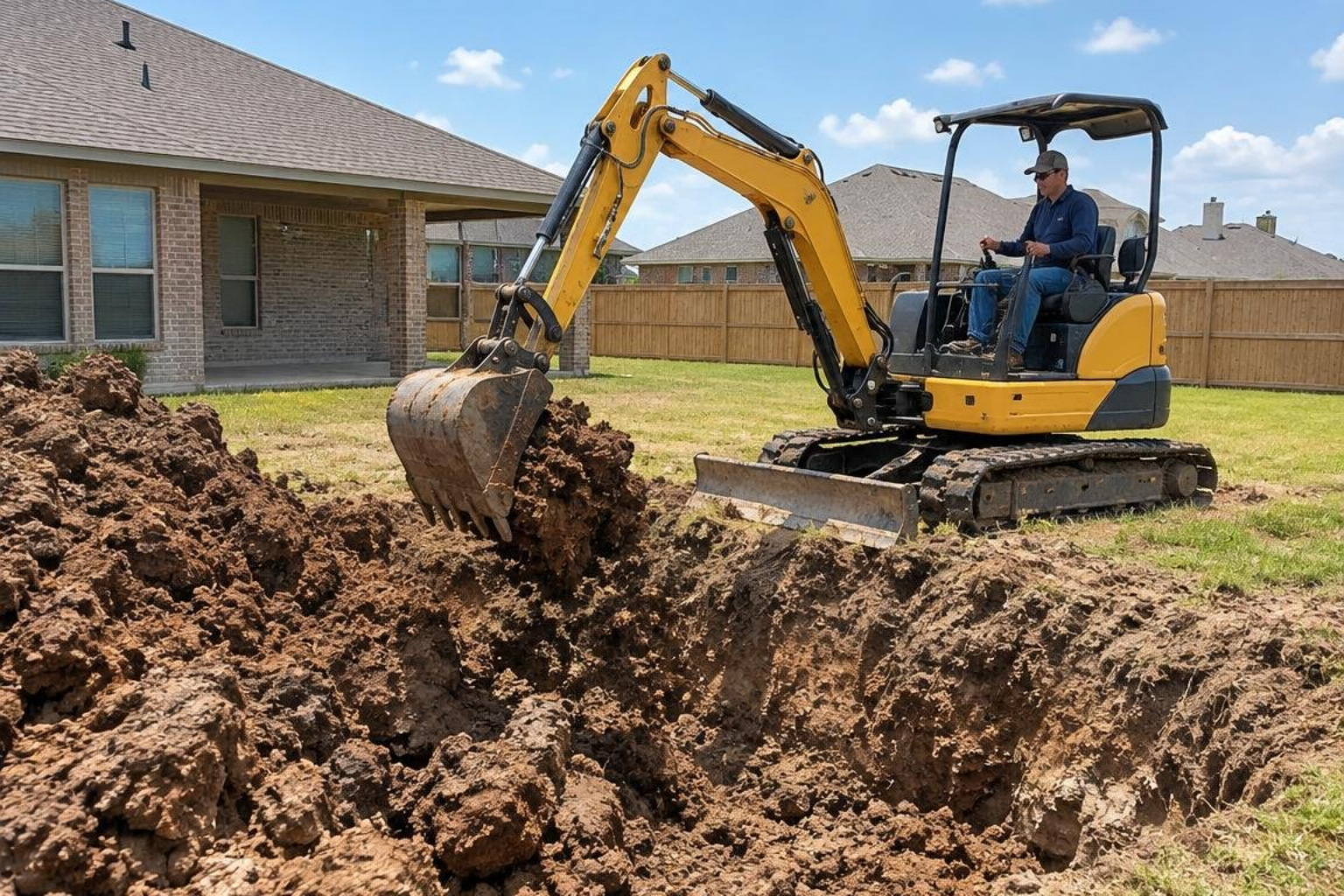
Before we can start spraying gunite pool material, the “heavy lifting” happens. We begin with excavation, where we dig out the exact dimensions of your pool. In the flat landscapes of Cypress or Spring, we pay close attention to drainage to ensure water moves away from your home.
Once the hole is dug, we install the “plumbing rough-in.” These are the pipes that will eventually circulate your water. After the pipes are in place, we build the “steel skeleton.” This is a cage made of #4 rebar, spaced according to a strict engineering schedule.
In Houston, we often use tighter rebar spacing (sometimes 12 inches on-center) and double steel beams in stress zones to account for our expansive clay soil. We use “dobies”—small concrete blocks—to hold the rebar several inches off the dirt. This ensures that when we spray the gunite, the steel ends up right in the middle of the concrete shell, where it provides the most strength. For a deeper look at these early phases, check out these Gunite Pool Construction Steps.
Can You Spray Gunite Over Existing Structures?
We often get asked if gunite can be used for renovations. The answer is yes! If you have an old concrete block pool or a structure that has seen better days, we can often perform a “pool-within-a-pool” renovation.
By installing a new rebar cage inside the old structure and spraying gunite pool material over it, we create a brand-new, structurally independent shell. We use specialized bonding agents to ensure the new gunite adheres perfectly to the old surface. This is a common way to save a failing pool while adding modern features like tanning ledges or benches.
The Big Day: The Process of Spraying Gunite Pool
“Gunite Day” is usually the most memorable part of the build. A large crew (usually 6 to 10 specialists) arrives early in the morning. You’ll see a large cement rig, a powerful air compressor, and hundreds of feet of heavy-duty hose.
The process is a coordinated dance. The “nozzleman” stands in the pool, directing the high-pressure spray. Behind him, “finishers” use long straight-edges and trowels to hand-sculpt the raw material into the smooth curves of your steps, benches, and walls. For a standard-sized pool in The Woodlands or Sugar Land, the entire spraying process usually takes about 6 to 10 hours.
The Technical Art of Spraying Gunite Pool
There is a real science to spraying gunite pool shells. The nozzleman is the most important person on-site. He controls the water-to-cement ratio with a valve on the nozzle. If the mix is too dry, it won’t stick; if it’s too wet, it will sag or “slump” off the walls.
The gunite is shot at a staggering 3,000 to 4,000 PSI. This high-velocity impact is what makes gunite so much denser and stronger than poured concrete. As the material hits the rebar, some of it bounces off—this is called “rebound.” A professional crew will constantly shovel this rebound out of the pool; it should never be used as structural material because it lacks the necessary cement-to-sand ratio.
Safety and Precision When Spraying Gunite Pool
Safety is our top priority. The crew wears protective gear, including respirators and eye protection, because the process creates quite a bit of dust. We also take great care to protect your home. We often use large tarps to shield your patio, windows, and landscaping from any stray spray.
Weather monitoring is also a big part of our job. While Houston heat is usually fine for gunite, we have to watch out for heavy rain. A light sprinkle won’t hurt, but a downpour can wash the cement out of the mix before it sets. If the forecast looks dicey, we’ll reschedule to ensure your pool’s structural integrity isn’t compromised.
The Curing Phase: Strengthening Your Pool Shell
Once the crew leaves, the pool looks like a gray, rough moonscape. But the work isn’t done! This is where the “curing” phase begins. Curing isn’t just “drying”—it’s a chemical reaction called hydration.
For the next 7 to 28 days, the gunite is undergoing a transformation from a wet mix into a rock-hard structure. To make sure this happens correctly, the shell needs to stay moist.
Why Watering Your Pool Shell is Vital
We ask our homeowners to water their pool shell 2 to 3 times a day for the first 7 to 10 days. Think of it like watering a new lawn. This prevents the outside of the gunite from drying faster than the inside. If it dries too quickly, the shell can develop “shrinkage cracks.”
In our humid Houston climate, this watering helps manage the “heat of hydration”—the internal heat generated by the chemical reaction. Keeping the shell cool and wet ensures it reaches its maximum design strength (reaching about 80% of its total strength in the first 28 days). For more on what to expect during this time, you can read our Gunite Pool Review.
Finishing Touches and Long-Term Care
After the curing phase, the shell is ready for the finishing touches. This includes:
- Waterline Tile: Installed at the top 6 inches of the pool to make cleaning easy.
- Coping: The stone or brick “cap” that sits on the edge of the pool beam.
- Interior Finish: This is the waterproof layer. You can choose classic white plaster, quartz, or premium pebble finishes.
In 2026, the national average for a custom gunite pool ranges from $60,000 to $110,000, though custom features in areas like Katy or Fulshear can certainly move that number. Once the pool is filled, you’ll want to budget about $2,700 a year for professional maintenance, chemicals, and electricity.
That while the gunite shell lasts a lifetime, the interior finish will eventually need a refresh. Plaster typically lasts 7-12 years, while pebble finishes can go 12-20 years before needing to be resurfaced.
Frequently Asked Questions about Spraying Gunite Pool
How long does the actual spraying take?
For most residential pools in Houston, the actual spraying gunite pool process takes exactly one day. The crew usually arrives at sunrise and finishes by late afternoon.
What happens if it rains during the spray?
If a sudden storm hits, we immediately stop and tarp the pool. If the gunite hasn’t been “cut” and finished yet, rain can cause a “washout.” We always check the radar in Tomball and Magnolia before we mix the first bag of cement.
How does gunite handle Houston’s shifting soil?
Gunite is designed to be slightly flexible despite being rock-solid. By combining the monolithic concrete shell with a heavy rebar cage, the pool can “flex” slightly with the expansive clay soil without structural failure.
Your Dream Backyard Awaits
At Ocean Blue Pools, we believe that the “Art of the Spray” is what separates a good pool from a great one. With over 25 years of experience building across Greater Houston—from the heights of Spring to the reaches of Richmond—we take pride in every nozzleman’s stroke and every finisher’s trowel.
We don’t just build pools; we build the backdrop for your family’s best memories. If you’re ready to transform that muddy hole into a backyard destination, we’re here to help with transparent pricing and southern-friendly service.